Web Application Development
We design and build web applications for business: client portals, internal portals, admin dashboards. We start with the business logic and data model, then build the backend, API, and interface — and maintain the system after launch. Based in Almaty, we run projects across Kazakhstan.
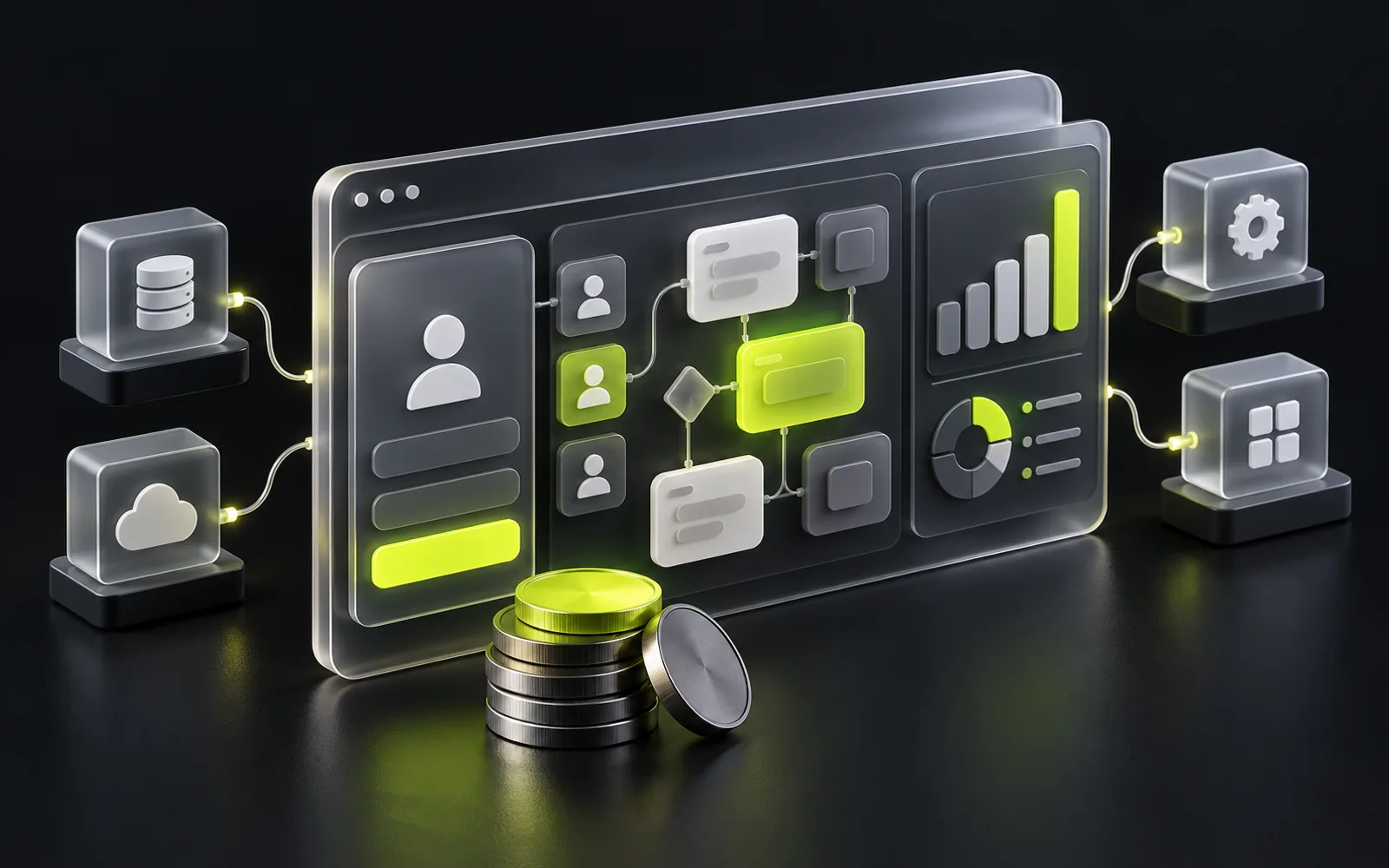
- Accounts
- Roles
- API

What is custom web application development?
Custom web application development means building a system around a specific company's processes: user accounts, roles and access permissions, business logic, a database, APIs, and integrations with external services. Unlike off-the-shelf platforms, such an application mirrors how the company actually works and scales along with it.
Who needs a web application
Businesses that have outgrown spreadsheets
Processes live in Excel and messengers: data gets lost, versions get mixed up, and the change history cannot be recovered. A web application brings it all into one system with roles, statuses, and an activity log.
Companies with client-facing service
Clients need a personal account: orders, statuses, documents, payments. The portal takes routine questions off managers' plates and makes the service transparent.
Teams that have outgrown off-the-shelf tools
A ready-made platform does not reflect your business logic: non-standard roles, approval stages, data requirements. You end up bending processes to fit the tool, when it should be the other way around.
Companies with scattered systems
Accounting in one program, requests in another, reports done by hand. A single web application connects the systems through APIs and becomes the workspace for your staff.
What web application development solves
How do we bring order to requests and client data?
A web application keeps requests, clients, and work history in one database. Roles and access permissions define who can see and edit what, and the change log shows who changed the data and when.
How do we give clients a personal account?
A client portal shows customers their orders, statuses, documents, and payments without calls to a manager. The company reduces the load on support; the client gets transparent service.
How do we automate internal processes?
Business logic moves into the application: approval routes, status changes, notifications, and reports are handled by the system rather than by hand. Employees work in one interface instead of a patchwork of spreadsheets and chats.
How do we connect the application to 1C, payments, and other systems?
Through APIs and integrations: the application exchanges data with accounting systems, payment services, and messengers. Data is entered once and syncs automatically, with no double entry.
Will the system handle a growing number of users?
It will, if scaling is built into the architecture: separating backend and frontend, task queues, caching, monitoring. Such a system can grow module by module without a rewrite from scratch.
What the work includes
items
- Analysis and design: user scenarios, data model, architecture
- User accounts and roles with access control
- Business logic: statuses, approvals, automated actions
- Backend and database with backups
- APIs for integrations and external clients
- Frontend: an interface that works on both phone and desktop
- Integrations with accounting and payment systems
- Product analytics: events, reports, dashboards for decision-making
- QA: testing of critical scenarios before every release
- Ongoing support: monitoring, updates, roadmap-driven development
How much a web application costs: InterLAB references
We launch the core — the minimum set of scenarios that already brings value — and grow the system based on data.
| Format | What is included | Reference | Timeline |
|---|---|---|---|
| Web app MVP | Key scenario, user account, roles, admin panel | 2–5 million ₸ | 6–12 weeks |
| Turnkey | Accounts for different roles, integrations, reports, API | 5–15 million ₸ | 2–4 months |
| Complex system | A portal or B2B platform with many roles and integrations | from 10 million ₸ | 4–8 months |
These are ranges, not a price list: we give an accurate estimate after a brief. The price is built from roles, scenarios and integrations, not from the number of screens.
Contract, payment and warranty
The same terms for every B2B project: payments are tied to accepted results, and a stage price does not change after it starts.
| Term | How we work |
|---|---|
| Payment for smaller projects | Projects up to 3 million ₸ and the MVP sprint: 50% upfront, 50% after acceptance |
| Payment for larger projects | ERP, CRM, SaaS, portals — in stages of 1–2 months: 30% before a stage, 70% after the stage is accepted and signed off |
| Stage price | Fixed before the start. New requirements are estimated separately and taken on only with your approval |
| Warranty | 6 months after acceptance: we fix defects in our code free of charge — whenever the system does not work as agreed |
| Not covered by the warranty | New features and changed requirements, as well as failures caused by changes in third-party systems (a 1C update, a new bank or service API) — that is support |
| Code and access | Owned by the client from the first commit: repository, servers and keys are on your accounts. NDA on your template or ours |
The terms are fixed in the contract before work begins.
Client portals, B2B portals and corporate systems
The three most common types of custom web applications. Technically they are built on the same stack; what differs is the users, roles and integrations.
| Criterion | Client portal | B2B portal or platform | Corporate portal |
|---|---|---|---|
| Who it is for | The company's clients who prefer to handle things themselves: orders, bookings, contracts, payments | Partner companies: dealers, wholesale buyers, suppliers, agents | The company's employees: office, branches, field teams |
| What it includes | Sign-up and sign-in, orders and statuses, documents and invoices, online payment, notifications, support requests | A catalogue with contract prices and terms, orders on behalf of a company, credit limit and deferred payment, invoices, delivery notes and certificates of completion, reconciliation of settlements | Requests and approvals (purchases, leave, business trips), documents and templates, a knowledge base, a staff directory, tasks and departmental reports |
| Typical roles | Client; a company manager who sees their own clients; administrator | A client company with its own users — head, buyer, accountant; the supplier's manager; platform administrator | Employee, department head, approvers (finance, HR), administrator |
| Integrations | CRM, 1C, payment services, WhatsApp and Telegram for notifications | 1C or an ERP (prices, stock, documents, settlements), CRM, electronic document exchange | Corporate accounts for single sign-on (SSO), 1C and the HR system, email and calendars, messengers |
| Where to start | With the one scenario clients most often call a manager about — for example, order status and documents | With repeat orders at contract prices for regular partners | With one approval process that currently runs over email and messengers |
The types can be combined: a B2B portal for partners and a corporate portal for employees can run on one database and one API, with different roles.
How development works
- 01
Brief and estimate
We break down the task, processes, and constraints. A preliminary estimate of timeline and cost comes after the brief.
- 02
Design
We describe scenarios, roles, and the data model, and design the architecture and API. This is also where we fix the scope of the first version — what goes into the launch and what moves to the roadmap.
- 03
Prototype
A clickable interface before the first line of code: user flows are validated up front, where changes cost the least.
- 04
Development and QA
Backend, frontend, and integrations are built in two-week iterations, each ending with a demo of a working version. Critical scenarios are covered by tests.
- 05
Launch and support
Release, monitoring, handover of access, and staff training. From there, the product evolves along the roadmap: new modules, optimization, scaling.
Get your project assessed before development starts
Describe the task in the form below — we reply within a business hour and suggest the next step: a call, a review or an estimate.
Architecture and stack
We build on TypeScript, Next.js, and Node.js with PostgreSQL: strict typing reduces the number of errors, and a widely used stack makes maintenance and handover easier. The architecture separates the interface, business logic, and data — the system can evolve piece by piece without disrupting the company's work.
- Next.js
- React
- TypeScript
- Node.js
- PostgreSQL
- Redis
- WebSocket
- Docker
- CI/CD
Integrations
A web application rarely works alone: we connect accounting systems, payment services, and messengers through APIs. Data syncs automatically — no double entry, no manual exports.
1C, Kaspi, Payment services, WhatsApp, Telegram, AmoCRM, Bitrix24, REST API
InterLAB projects in this area
Real work with a dated status: what's live, what's still in development, where it's a demo.
status as of Oct 12, 2026
Frequently asked questions
InterLAB references: a web app MVP is 2–5 million ₸ and 6–12 weeks, a turnkey product is 5–15 million ₸ and 2–4 months, complex systems with many roles and integrations start from 10 million ₸ and take 4–8 months. These are ranges, not a price list: we give an accurate estimate after a brief — the price depends on the number of roles, scenarios and integrations.
A website tells people about the company; a web application does the work: authentication, user accounts, business logic, data processing. An application has a backend, a database, and user roles — a website usually does not.
An online store sells to everyone at the same prices, with payment at checkout. A B2B portal works with companies under contract: each partner has its own prices and payment terms, several of the company's employees place orders with different permissions, and payment can be made by invoice with a deferral within a credit limit.
Yes. The portal is built as a separate web application — usually on a subdomain of the website — and gets data on orders, documents and payments from 1C or the CRM through an API. The website does not need rebuilding, and accounting stays in the familiar system.
A CRM is a system for working with clients and sales: contacts, deals, the pipeline. A corporate portal is the employees' workspace: requests and approvals, documents, a knowledge base, a staff directory. If the tasks overlap, one web application can cover both — in different sections, with shared roles and single sign-on.
You can, and you should. We define the core — the minimal set of scenarios that already delivers value — and launch it first. The system then grows module by module along the roadmap, without a rewrite from scratch.
The client: the repository is created in your organization, and the infrastructure is registered to your accounts. If the engagement ends, you take the code, access credentials, and documentation with you.
Ongoing support: monitoring, backups, updates, and feature development along the roadmap. The scope of support is agreed separately — from standby monitoring to a dedicated team.
We will. First comes a technical audit: architecture, security, technical debt. Based on the results, we draw up a refactoring and development plan; InterLAB can carry out the work.
Deep dives in the blog

Related services


Got a project?
We'll scope and estimate it — for free.
Tell us about the product or the problem. After reviewing the task we'll come back with an architecture, a timeline and a price for the first version.
- Scope and risks estimated before we start
- NDA — yours or ours
- Work starts within a week