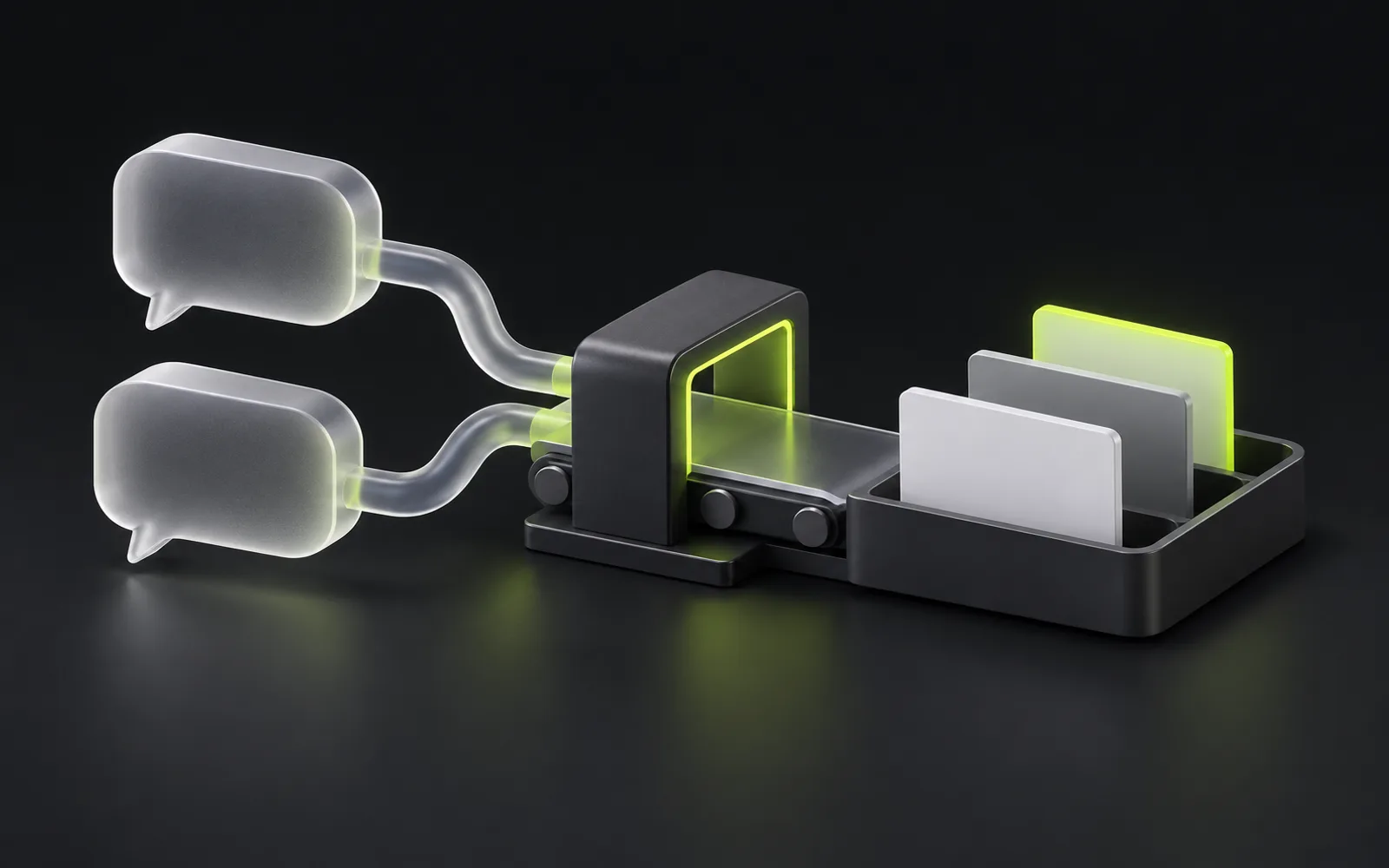
Automating lead intake in messengers has four parts: a bot or agent accepts the enquiry and asks qualifying questions, the lead lands in your CRM, spreadsheet or 1C automatically, a manager gets a notification with full context, and the customer receives reminders and status updates. InterLAB's reference: one automated process from 500k ₸ in 2–4 weeks, department-level processes from 1.5M ₸. These are lower bounds; we give an exact estimate after a brief.
Discuss your project?
A timeline and cost estimate broken down by stage — after the brief.
Contents
What can be automated in messengers
Automate what repeats in the same way from customer to customer. Decisions that need a person stay with the manager: the system's job is to bring the customer to that person quickly and with the context already collected.
Lead intake and qualification
- What the system does
- Greets, asks 3–5 questions (service, city, budget, timing), records the answers
- What you need
- A list of questions and criteria for a hot lead
Booking an appointment or service
- What the system does
- Shows free slots, books, confirms
- What you need
- Access to a schedule or calendar
Reminders
- What the system does
- Sends a reminder about a booking, payment or visit
- What you need
- Customer consent, message templates
Order status
- What the system does
- Reports that the order is accepted, packed, shipped
- What you need
- A link to your accounting system or order sheet
Hand-off to a manager
- What the system does
- Connects a person when the bot cannot help or the customer is ready to buy
- What you need
- Hand-off rules, a manager on duty
How a lead reaches your CRM, spreadsheet or 1C
- 01Telegram / WhatsApp
- 02Bot or agent
- 03CRM / sheet / 1C
- 04Manager
The main rule: a lead must not live only in a chat. Each enquiry becomes a record with fields: name, contact, what is needed, source, the bot's answers, time of enquiry. Where you send it depends on the tools you already use.
- Spreadsheet: fine at the start, while there are few leads and one or two people handle them.
- CRM: needed once you have a pipeline, several managers, tasks and response-time control.
- 1C: the lead or order goes into accounting and statuses return to the customer in the messenger; this two-way link is more complex than a one-way export.
If you do not have a CRM yet, start with a spreadsheet and clear fields and add the CRM later: scope and cost are covered in the article «How much does CRM implementation cost». For choosing where to begin, see «Where to start automating your business».
Scripted bot, operator with prompts, or AI agent
Scripted bot (buttons and fixed questions)
- Fits when
- Questions are standard and answers can be listed in advance
- Limitation
- Cannot handle free text outside the script
Operator with prompts
- Fits when
- Decisions are non-standard and a person is accountable
- Limitation
- Response speed depends on shifts and workload
AI agent
- Fits when
- Many free-form questions, answers come from a knowledge base
- Limitation
- Needs boundaries: what the agent may say and what it only hands to a person
Platform limits and personal data
Platform rules shape the scenarios, so they are taken into account at the design stage.
- WhatsApp Business: when a customer writes to you, a 24-hour response window opens; free-form messages can be sent only while it is open, and outside it you need pre-approved templates.
- WhatsApp Business: you may message people only with their opt-in for subsequent messages; the business chooses the opt-in method and is responsible for it.
- Telegram: bots have sending-rate limits, so mass broadcasts to a large base are planned in advance; in a single chat you should not send more than one message per second.
- Platform terms change, so check them against current documentation before launch.
Launch steps
Describe the customer path
Where enquiries come from, what people ask most, where leads get lost.
Design the scenario
Bot questions, hand-off rules, message templates for WhatsApp.
Connect channels and your system of record
Telegram, WhatsApp, CRM, sheet or 1C; check that a lead is neither lost nor duplicated.
Pilot run
Run on part of the flow with live monitoring: which questions the bot missed, where customers drop off.
Launch and refine
Full flow, a report on response time and lead count, fixes based on real conversations.
We demo the working version every 2 weeks, and the code and access belong to the client from the first commit.
What the cost consists of
One process (e.g. lead intake and hand-off to CRM)
- Depends on
- Number of channels, questions and hand-off rules
- InterLAB reference
- from 500k ₸, 2–4 weeks
Department processes (leads, bookings, statuses, reports)
- Depends on
- Number of scenarios and roles
- InterLAB reference
- from 1.5M ₸, 1–3 months
Integration with CRM, sheet or 1C
- Depends on
- One link or two-way exchange
- InterLAB reference
- one link from 400k ₸, two-way exchange from 1M ₸
Support and further work
- Depends on
- Conversation volume, how often things change
- InterLAB reference
- determined individually
InterLAB's references are lower bounds; we give an exact estimate after a brief. Platform services are paid separately: access to WhatsApp Business Platform and messages through providers are billed under their terms, so include them in the budget.
Common mistakes and a checklist
- The bot asks ten questions in a row: the customer leaves. Three to five key ones are enough.
- No clear hand-off to a person: the customer is stuck in a dialogue with the bot.
- Leads stay in the chat and never reach the CRM or sheet.
- Broadcasts without consent: customers complain and block the business.
- No process owner: nobody reads the conversations and improves the scenario.
- The customer path and the most common questions are described.
- It is defined where a lead goes and who handles it.
- There is a hand-off rule and a manager on duty.
- Customer consent for messages and data processing is built into the scenario.
- WhatsApp message templates are prepared in advance.
- A process owner is appointed on the company side.
- Metrics are set: first response time, number of leads, share handed to a manager.
Discuss your project?
A timeline and cost estimate broken down by stage — after the brief.