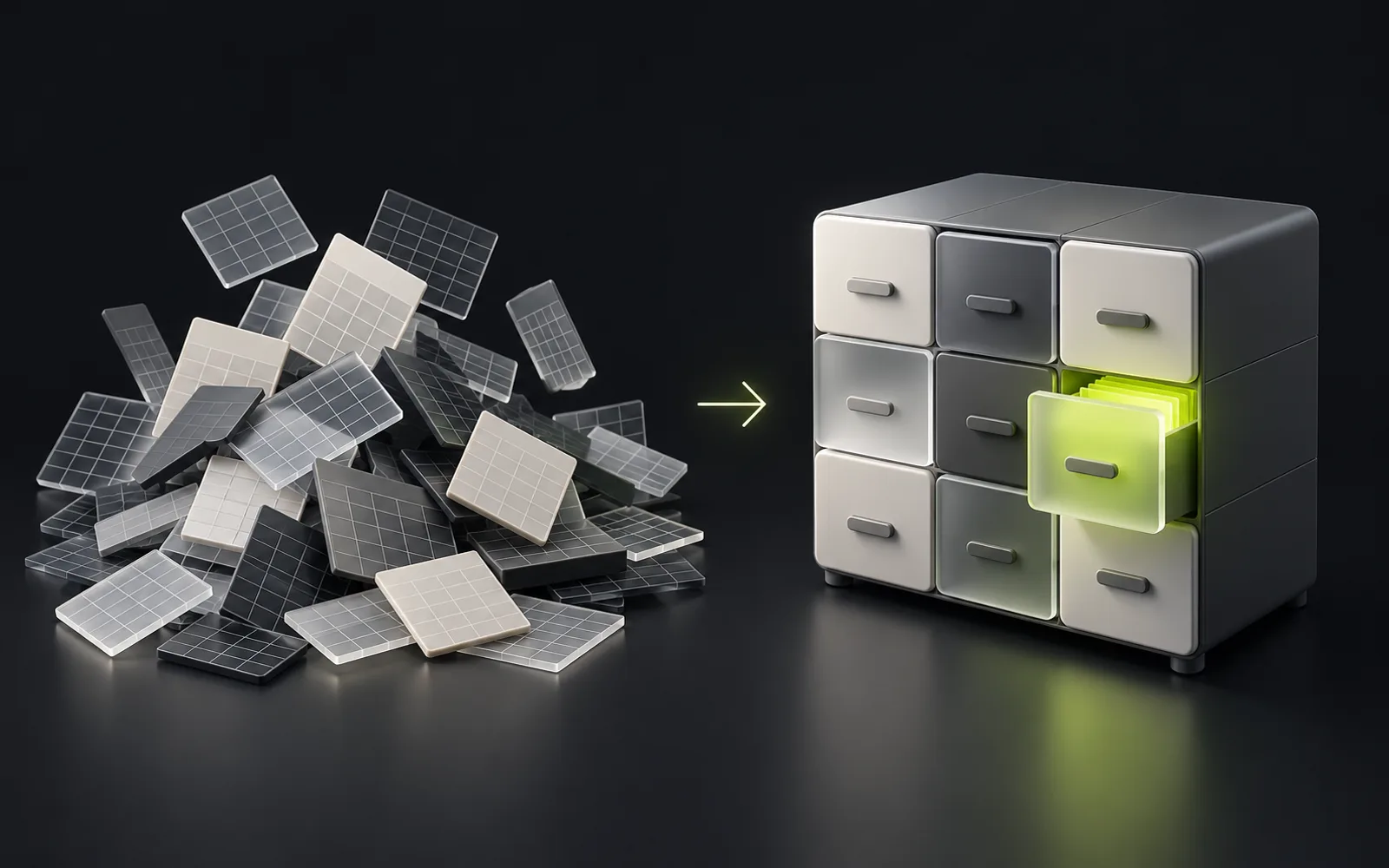
Custom software has no price list: the cost is determined by the number of business processes and roles, the count of integrations, the volume of data to migrate, and the reliability requirements. For reference, InterLAB's ranges: a product MVP at 2–5 million ₸, a turnkey product at 5–15 million ₸, complex systems from 10 million ₸; an exact stage-by-stage estimate takes after the brief, and the first phase can almost always be smaller thanks to staging. This article is about what the number is made of and how to compare proposals.
Contents
Why custom software has no price list
A custom system is not an off-the-shelf product but a cast of a specific company's processes.
A custom system is not an off-the-shelf product but a cast of a specific company's processes. "A CRM for the sales team" at a company with one pipeline and at a company with three business lines, branches and approval chains are two projects of different complexity — even though the emails call them the same thing.
Contractors' proposals can only be meaningfully compared by scope: what exactly is included, what is not, and what will count as a change request.
The good news: the list of factors the price is made of is universal and short. Knowing it, you can read any estimate.
Six factors that determine the cost
In order of impact on the final number:
Number of processes and roles
- What's behind it
- Every process means screens, logic and permissions; a system "for a manager and an accountant" and one "for six departments" are different scales
Integrations
- What's behind it
- Exchange with 1C, payment services, the warehouse, messengers — each connection is designed, built and tested separately
Data and migration
- What's behind it
- Moving a hundred-item catalog and reconciling five years of records from a dozen spreadsheets are incomparable tasks
Reliability requirements
- What's behind it
- A system you can "restart in the morning" and one that stops shipping when it's down are built differently: redundancy, logging, monitoring
Interfaces
- What's behind it
- How many screens and who uses them: an admin panel for two of your staff and an account area for a thousand clients demand different levels of polish
Support and growth
- What's behind it
- Software lives longer than it takes to build; what maintenance costs is a question to ask BEFORE the start, not after
What makes a project cheaper
Cost is not a verdict — it can be managed. Working levers:
- Staging: the first phase covers the process with the biggest losses, the rest follows the roadmap; you don't have to pay for everything at once.
- Ready components where there's no specificity: authentication, payments and notifications are long solved — what should be custom is your business logic, not the login form.
- A mainstream stack: technologies with a large talent market are cheaper both to build with and to support for years.
- Clear boundaries: a recorded list of what is NOT in the first phase protects the budget better than any negotiation.
- Client readiness: process descriptions, sample documents and system access prepared in advance shorten the analysis stage.
Hidden costs people forget
When planning the budget, account for:
- Infrastructure: servers or cloud, backups, domains — a recurring payment, not a one-off.
- Third-party licenses: payment gateways, SMS, e-document services take their commission or subscription.
- Training and rollout: your staff's time to switch is real hours worth planning.
- Maintenance: updates, monitoring and small fixes after launch.
- Evolution: company processes change — the system must change with them, and that's a normal budget line, not "they built it wrong".
InterLAB's reference ranges — and what "flexible" means
We publish our ranges openly — as a scale reference, not a price list.
Product MVP
- Budget
- 2–5 million ₸
- What's included
- The core scenario, backend, admin panel, analytics, release in 6–12 weeks at a fixed price
Turnkey product
- Budget
- 5–15 million ₸
- What's included
- Several roles, integrations, customer accounts, production rollout
Complex systems
- Budget
- from 10 million ₸
- What's included
- Multi-module, with dozens of processes and deep integrations
Now the important part — flexibility, because a range is scary only until you see how it works. Price is a function of scope: by removing everything non-critical from the first phase, the budget goes down in a controlled way. Almost every "turnkey" project can start as an MVP from the lower end of the range — prove the core, then roll out the rest by roadmap on a product that's already working.
How to read estimates — and where they usually lie
Three red flags when comparing proposals — and the mirror rule for an honest estimate.
Red flags
- A single number with no breakdown: you can't see what's inside, so any comparison is meaningless.
- An estimate without migration, training and support: the most common "surprises" live exactly there, so ask about them directly.
- An hourly rate with no target total: the rate looks low, but without a scope estimate it's not a price, it's a taxi meter.
An honest estimate
- A stage-by-stage breakdown.
- An explicit "not included" list.
- Named support terms.
An estimate like that can be compared with others and defended in front of management.
How to get an honest estimate
Prepare three things for the conversation:
- A list of processes the system must cover (in plain words, no tech terms).
- A list of roles — who does what in it.
- A list of systems it must exchange data with.
That's enough for a contractor to size the work.
At InterLAB, from a brief like that we come back after reviewing the task with an estimate: a breakdown by stage, what goes into the first phase, what is deliberately postponed, and what support costs. The decision is then yours — the estimate is built to be verifiable and comparable.